Debbie Hepplewhite's
Online Synthetic Phonics Programme - a programme with an extensive range of practical resources to provide for all ages, needs and contexts
Unit 1 (of 12 Units)
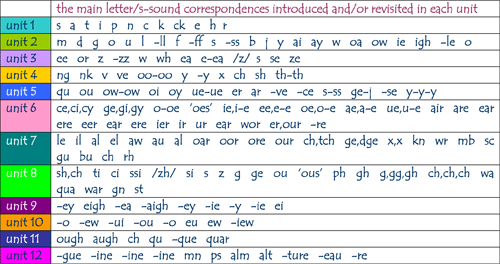
Our programme is divided into 12 units and consists of highly practical resources which will be helpful to anyone who wishes to teach and learn the English Alphabetic Code. Whatever the age of the learner, it is the same Alphabetic Code and skills of blending all through the printed word for reading and segmenting all through the spoken word for spelling which need to be learnt.
The entire contents of Unit 1 of this programme are FREE to download! Details of how to purchase the remaining 11 units can be found at the bottom of this page.
Click the symbol to open a file
* See notes at the foot of this page if you experience any difficulties in opening these files.
ò
THE OVERVIEW AND GUIDANCE BOOKLET-This is where you start! As new resources are constantly being added, please refer to the Phonics International Message Forum for any up-to-date additions to the programme. This booklet will be updated periodically.
Please note that the detailed information for introducing each new letter sound correspondence is included on every 'Sounds Book Activity Sheet'.
The Sounds Book Sheets are the core of this programme
and the download section can be found highlighted below.
- HOW TO SET UP AND USE YOUR CORE AND ESSENTIAL PHONICS INTERNATIONAL RESOURCES It is highly recommended that you read this information and guidance document including the information via the electronic links (all links lead to guidance documents except for the links which go to the ‘shop’):
*
CORE TEACHER MODELLING CARDS
Very helpful teacher-led ‘lesson introduction’ material for every new, or focus, letter/s-sound correspondence in Units 1 to 12:
This resource was originally provided only in Units 1 to 6 of the Early Years Starter Package webpage (alongside a pupil-version with line drawings). It has proved to be such a helpful and popular resource for adults to introduce the new or focus letter/s-sound correspondence that it has now been added to the full Phonics International programme and extended to Units 7 to 12.
The CORE TEACHER MODELLING CARDS’ include the same key pictures and example words which are used on the Phonics International English Alphabetic Code Charts. The ‘teacher’ is advised to point to the focus sounds and graphemes on the preferred version of the Alphabetic Code Charts as part of the introduction to the lesson. Then the CORE TEACHER MODELLING CARDS provide the ‘teacher’ – whether for whole classes, groups or individuals - with a comprehensive all‐in‐one resource to introduce the new or focus letter/s-sound correspondence/s whilst also providing the word examples to model the three core skills of:
sounding out and blending all‐through‐the‐printed‐words for reading (decoding: this is a print-to-sound process)
orally segmenting all‐through‐the‐spoken‐words for spelling (encoding: this is a sound-to-print process)
handwriting the new letter/s‐sound correspondence and, further, applying handwriting to spelling
[Please refer to the following pdfs for information about the phonics routines for the ‘core’ skills:
Three Posters for Phonics Routines – Reading, Spelling, Handwriting
Guidance for Phonics Routines]
NOTE: AVOID OVER-MODELLING! As soon as learners are picking up the code knowledge and the phonics routines for the skills of blending for reading, and oral segmenting for spelling, the teacher can encourage the learners to go through the information and processes on the CORE TEACHER MODELLING CARDS with the teacher, and then ahead of the teacher to increase the engagement and participation of the learners. So, the teacher can point under the graphemes of the words to be blended, but the learners ‘say the sounds’ and then the ‘whole spoken word’ and so on. Teachers need to be excellent at modelling the phonics routines BUT KNOW WHEN TO HOLD BACK AND LET THE LEARNERS DO THE WORK!
ALSO, point out, as appropriate for the age and needs of the learners, any features of the example words that you may want to touch upon such as prefixes, suffixes, word classes, root words, pronunciation variations, word meanings, unusual spellings and so on.
Suggestions: Providers in school and pre‐school settings can use this as a paper or laminated resource (reduce to half-size in the home if preferred or view on screen, use as the original A4 size or enlarge to A3 if required with whole classes – or view on a screen or project onto a whiteboard during the introduction). After using paper or laminated CORE TEACHER MODELLING CARDS to introduce the new alphabetic code and three core skills, the cards can be immediately transferred to the main display wall to systematically build up a set of posters to support continuous learning. In addition, you could create a browse-book of this resource which learners can access in a book corner or library.
The CORE TEACHER MODELLING CARDS can be used as a stand‐alone lesson introduction resource or used alongside other Phonics International multi‐sensory aids. The PICTURE POSTERS (visual resource) and online ‘HEAR THE SOUNDS’ (audio‐visual resource) in Units 1 to 6 provide picture/word examples with the focus letter/s‐sound correspondence (especially helpful when English is being taught as a foreign language by teachers who are non-native speakers).
IMPORTANT: Aim to follow the teacher-led lesson introduction with each learner using his or her own paper copy of the core SOUNDS BOOK ACTIVITY SHEETS alternating with the matched ‘SENTENCES’ (In Units 1 to 5) and/or the ‘I CAN READ’ TEXTS and QUESTIONS in Units 1 to 12.
Go to the Early Years Starter Package webpage if you require additional sentence level material ‘SIMPLE SENTENCES’ and text level material ‘BOOKLETS’ for Units 1 to 6. The Early Years Starter Package also has different versions of the multi-skills ACTIVITY SHEETS – very good for younger learners and/or for beginners when English is a new language.
It is important that teachers distinguish between teaching 'the alphabetic code' (the links between letters or letter groups and their corresponding 44+ sounds for reading; and between sounds and letters or letter groups for spelling - referred to as 'letter/s-sound correspondences' in the Phonics International programme) - and 'the alphabet' (the 26 upper case and 26 lower case letter shapes, the letter names and alphabetical order). Resources within the Phonics International programme include a range of ALPHABETIC CODE CHARTS and ALPHABET POSTERS. (See also www.debbiehepplewhitehandwriting.com for further alphabet posters and handwriting resources.)
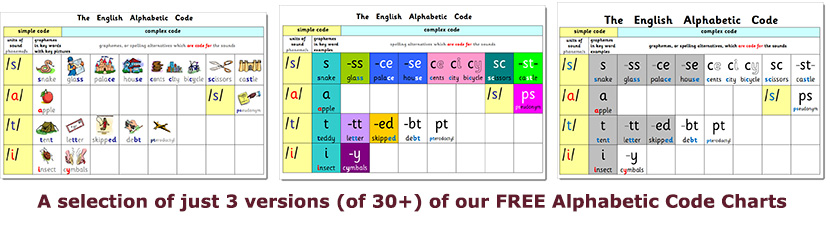
The notion of the ALPHABETIC CODE CHART is the central organisational, and essential, visual aid for teaching and learning purposes - and for informing parents and carers of learners as appropriate. Debbie has designed a number of ALPHABETIC CODE CHARTS for different purposes - for example, 'giant' versions for main visual display in classrooms (or homes), and 'mini' versions for planning and tracking purposes for teachers, and for learners' personal phonics folders, and for schools' literacy policies.
Debbie's ALPHABETIC CODE CHARTS can be used to supplement, or complement, other systematic synthetic phonics programmes - or they can be used for general alphabetic code information in any classroom to support the schools' spelling programme or practice - and to support an understanding of the English alphabetic code generally.
Some versions have additional alphabetic code information and include descriptions of the 'synthetic phonics teaching principles' and are therefore ideal for teacher-training purposes. They are used in some universities for training student-teachers. Please approach us if you would like to use any of our charts in published material.
The ALPHABETIC CODE CHARTS have been provided via this free Unit 1 webpage since the launch of the Phonics International programme in 2007 - but from 2013, they have been revised and uploaded onto a purpose-designed website: www.alphabeticcodecharts.com . Over 30 charts remain free to select from and download and our commitment remains to provide free downloadable Alphabetic Code Charts.
ESSENTIAL: If you are using the Phonics International programme in your school, please ensure that you visit the ALPHABETIC CODE CHART website to select the Phonics International charts as preferred.
PLEASE NOTE: In response to constant requests over several years for ready-made Alphabetic Code Charts in durable materials, we now provide a selection of charts made in different sizes, different materials and for different purposes. There are versions available in both the Phonics International 'order' of introducing the sounds and also in a more generic order of introducing the consonant sounds separately from the vowel sounds. If you are interested in investigating our ready-made charts, you can find these via our online 'shop' - Click HERE
AUDIO AND VISUAL RESOURCES
HEAR THE SOUNDS which introduce the 44+ sounds (phonemes) in the English language Hear the same phonemes modelled in all positions in the words which feature on the phonemic awareness Picture Posters. This facility is available for units 1 - 6. (Switch on PC speakers!)
PICTURE POSTERS Simple phonemic awareness posters illustrating the relationship between sounds (phonemes) in words and letters(graphemes) in written words. The words are non-cumulative as the learner is not expected to decode these words. This strand runs through units 1 - 6.
POSTERS TO SUPPORT SYSTEMATIC TEACHING AND LEARNING THROUGHOUT THE PROGRAMME
ALPHABETIC CODE FRIEZE POSTERS A4 frieze posters for every new grapheme (letter or letter group) introduced. Lower case grapheme is highlighted. Relative sizes and position of capital letters and lower case letters are shown on a writing line.In units 1 - 12.
ALTERNATIVE 'TENT' ALPHABETIC CODE FRIEZE POSTER
GROUPING THE SPELLING ALTERNATIVES POSTERS - WITH ILLUSTRATIONS These A4 posters (62 throughout the 12 units) group the spelling alternatives for the focus sounds in each unit. They can be used to complement the main ALPHABETIC CODE OVERVIEW CHART and THE ALPHABETIC CODE FRIEZE POSTERS. From unit 7 onwards, a spelling alternative is occasionally included on a poster in advance of its formal introduction in a later unit. This helps with raising awareness of spelling alternatives for reading and writing activities in the wider curriculum. (Please see the DRAW THE PICTURES resource which provides an optional activity for the learner to embed the Alphabetic Code information in memory.)
GROUPING THE SPELLING ALTERNATIVES POSTERS - DRAW THE PICTURES - (no illustrations included)
These optional ‘activity sheets’ are the same design as the A4 posters which group the spelling alternatives for the focus sounds in each unit - but they do not include the illustrations. The learner draws the illustrations for the key words and this activity helps to embed the Alphabetic Code information in memory.
MINI-POSTERS Simple posters to track the sounds in spoken words with the letters in written words. The words start off being non-cumulative - but after the first few posters, all the words are cumulative. A good time to introduce each poster is just before you introduce and use each Sounds Book Activity Sheet. This strand continues throughout the programme in units 1 - 12.
THE SOUNDS BOOK ACTIVITY SHEETS AND GUIDANCE
SOUNDS BOOK ACTIVITY SHEETS Debbie's programme is built around these essential activity sheets. With each successive sheet, a new letter/s-sound correspondence is introduced; cumulative words are provided for blending; handwriting practice links shape to sound; picture drawing provides phonemic awareness rehearsal, pencil control, vocabulary development and a personal mnemonic system; and a segmenting, handwriting and editing routine rehearses spelling. Thus, all the necessary knowledge and skills teaching and learning is focused on one activity sheet! Each sheet includes detailed guidance and, when used in school, these activity sheets can be sent home to inform parents and guardians. This strand runs throughout units 1 - 12.
COLOUR-IN SOUNDS BOOK The A5 Colour-in Sounds Book sheets include a key word (non-cumulative) with a key colour-in picture and three cumulative words to blend (some non-cumulative words in unit 1). ‘Tracker font’ provides some handwriting practice for the focus grapheme. These can be used when new letter/s-sound correspondences are introduced. They can be collated in a scrap book to make a ‘Code Book’ or ‘Sounds Book’. Provided in units 1 to 12.
LETTER TO PARENTS Choice of two letters to send home to parents about management of the Sounds Book sheets. In unit 1. (Version 1)
LETTER TO PARENTS Choice of two letters to send home to parents about management of the Sounds Book sheets. In unit 1. (Version 2)
GUIDANCE TO SUPPORT EARLY READING One side of A4 ideal for sticking into school reading record books.
GAMES AND ACTIVITIES TO SUPPORT TEACHING AND LEARNING
BOOKMARKS
There are several different BOOKMARKS available to print throughout the programme. These useful resources can be used as ‘bookmarks’ and also for supporting the teaching and learning of letter/s-sound correspondences (from print-to-sound for a reading sub-skill and from sound-to-print for a spelling sub-skill). Print on paper, or card - or laminate paper copies for additional durability.
PICTURE CARDS These are pictures to raise awareness of the individual sounds, or phonemes, that make up spoken words. They can be used in many different ways including using them along with the phonemic awareness Picture Posters.
This strand runs throughout Units 1 - 6.
GUIDANCE FOR USING THE PICTURE CARDS Sets of the PICTURE CARDS are available in units 1 to 6 for developing phonemic awareness (the awareness of sounds within words). This resource is TEACHERS’ GUIDANCE and is available for supporting the use of each set of the Picture Cards in units 1 to 6. Examples are provided of how spoken words can be segmented (split up) into their constituent phonemes (sounds). Note that the phonemes are denoted between slash marks in this guidance and that this is for the teachers’ information and use - NOT for the learners!
GRAPHEME TILES (BLACK/GREY) Ideal sized grapheme tiles for manipulating words (making and breaking). These can be used for various spelling activities including making up independent spelling games with selected Picture Cards. They would be better printed on card or laminated. Ideally laminated Grapheme Tiles could be made into magnetic tiles with sticky-backed magnetic tape. They can then be used on the teacher’s main magnetic board or with A3 magnetic board for pairs or individual work. The Grapheme Tiles are printable in all ‘dark teal’ (which can be black if printed in monochrome) and they are available in sets with grey graphemes for consonant phonemes and black graphemes for vowel phonemes. These are also suitable for sending home for additional word making and breaking rehearsal. They would be suitable for ‘fridge magnets’. Provided as sets per each unit 1 to 12.
GRAPHEME TILES - AS ABOVE DESCRIPTION - IN DARK TEAL
LETTERS, SOUNDS AND PICTURES MATCHING GAME A cumulative card game provided on 21 x A4 sheets spread over units 1 to 6. This game is ideal for supporting the learning of the sub-skills for decoding (reading) and encoding (spelling). In total there are 105 pictures each with teacher clue cards and grapheme cards. The teacher cards provide full information for segmenting the focus word. The set of cards in each unit includes an information sheet. Use this game to support the main teaching of new letter/s-sound correspondences. In units 1 to 6.
s, a, t, i, p, n PAIRS GAME Ideal for school and home. Teach that capital letters are code for the same sounds as the lower case equivalent letters. The lower case letter cards are great for making words to read and for early spelling routines. Letters are presented on lines.
c, k, ck, e, h, r PAIRS GAME Provides letter cards for word making and spelling as well as playing the Pairs Game. Pairs Game packs are in units 1 - 6.
SAY THE SOUNDS BOOKLET These A5 booklets are designed for learners to rehearse and learn the latest letter/s-sound correspondences to automaticity. The pages of the booklets are clipped together with a paper clip and the teacher releases each page as the new correspondence is introduced. The booklet can go between school and home for ‘little and often’ practice of saying the sounds. There is a list of all the letters/s-sound correspondences of the unit at the back of each booklet for a final assessment. To make the booklet, slice the A4 pages in half (now creating 2 x A5 sheets), put the letter/s-sound correspondences in the order that they are introduced in the programme with the A5 sheet of all the graphemes at the back. Staple the left-hand side to make the booklet. There is one booklet each for units 1 to 5 and two booklets for unit 6.
SAY THE SOUNDS POSTERS Three 'Say the Sounds' Posters per unit for units 1 - 5. The first three are included in unit 1. These are very useful cumulative resources. They can be A4 or A3 posters displayed in the classroom for learners to point and 'say the sounds' (subskill of reading) or the teacher can say the sound and ask the learner to 'point to the grapheme' in response (subskill of spelling). In addition, paper versions of the Say the Sounds Posters can be used as assessment sheets for each learner. Name, date and mark in a different coloured pen for ongoing assessments. Provide an unmarked copy for the learner to use for actual assessment. Beginners will benefit from a copy of a Say the Sounds Poster used alongside the Alphabet Mini Poster to support writing activities during the STAGE ONE phase of learning. These posters are also available in the STAGE TWO phase of learning in units 6 to 12.
SPELLING SHEETS WITH WORD CHECK LIST (can also be used as a RECORD-KEEPING LIST) This strand includes 40 different Spelling Sheets spread over the first six units. They are best used once learners have a good grasp of the segmenting skill, and they are familiar with the Alphabetic Code knowledge taught to date, therefore consider using them at the end of each unit. In these spelling activities, pictures provide the stimulus for spelling words. Grapheme lists and sound-dashes are provided to support the spelling process. At first the learner can ‘say the sounds’ for the graphemes listed at the top of the spelling sheets. The graphemes list can also be used to select GRAPHEME TILES or magnetic letters or CanDoCubes for an optional kinaesthetic spelling activity instead of, or prior to, writing down the spellings. For a more challenging activity, fold over or cut off the graphemes list for learners to spell without sight of them. Available in units 1 to 6.
SETS OF FLASH CARDS
GRAPHEME FLASH CARDS WITH PICTURES These are OPTIONAL picture mnemonic (aid to memory) flash cards in units 1 to 12. When the learner can recognise a letter shape (or letter group) WITHOUT the picture mnemonic, replace that card with a flash card of the letter/s (graphemes) only. Start off by BUILDING UP the pack of flash cards as you introduce each new letter/s-sound correspondence. In unit 1, for example, at first there will only be ‘s’ in the pack, followed by introducing ‘a’, then ‘t’, then ‘i’ and so on (follow the order of the programme). The aim is for the learner, as soon as possible, NOT to use the picture cues. Focus on the AIM of saying the sound in response to the letter/s without the need for the pictures. Make it clear to the learner whether the corresponding ‘sound’ represented by the focus letter/s (graphemes) is at the beginning of the word (as in ‘s-nake’) or in the middle of the word (as in ‘n-igh-t’) or at the end of the word (as in ‘du-ck’). In units 1 to 5, the dashes on some cards represent the number of ‘sounds’ in the spoken word and NOT individual letters - this is just to support the ‘mapping’ of initial-medial-final sounds to their position in the spoken word. The Flash Cards with no pictures are included as part of this resource. In units 1 to 12.
LETTER/S-SOUND CORRESPONDENCE FLASH CARDS (WITH LINES) - UNITS 1 - 5
Essential kit for small-step, multi-sensory teaching and learning. A few additional cards include 'air' and 'eer', split digraphs and some blank cards. Follow-on flash cards for STAGE TWO are available un Unit 6.
LETTER/S-SOUND CORRESPONDENCE FLASH CARDS (WITHOUT LINES) - UNITS 1 - 5 Essential kit for small-step, multi-sensory teaching and learning. A few additional cards include 'air' and 'eer', split digraphs and some blank cards. Follow-on flash cards for STAGE TWO are available un Unit 6.
GIANT LETTER/S-SOUND CORRESPONDENCE FLASH CARDS FOR LARGE GROUPS/WHOLE CLASSES (WITHOUT LINES) - UNITS 1 - 5 Essential kit for small-step, multi-sensory teaching and learning. A few additional cards include 'air' and 'eer', split digraphs and some blank cards. Follow-on flash cards for STAGE TWO are available un Unit 6.
WORD FLASH CARDS This strand of large WORD FLASH CARDS is available in all the units 1 to 12 as an optional resource. It is not intended that the words on these flash cards are taught as ‘whole global shapes’. These words are ‘cumulative’ and can be used to model and rehearse the sounding out and blending process as learners are introduced to the letter/s-sound correspondences in each unit. Eventually, familiarity from blending these words will lead to learners recognising them automatically. The same words can be found on other PI resources. Teachers can model the words in simple spoken or written sentences and describe the meanings of the words if the learners do not know them. This will increase the vocabulary bank of the learners. These WORD FLASH CARDS may make a useful ‘hard copy’ resource for the ‘simple code’ units when learners are total beginners. Teachers can use them in front of groups and whole classes. In these circumstances, teachers should track under the graphemes (with the index finger) from left to right in the printed words whilst the graphemes are sounded out. When the whole word is said, the teacher should return to the beginning of the printed word to track under the whole word in time with the spoken word. Learners can have access to hard copies of the cards for reading them independently. When computers are available, learners can read the words ‘online’ with support or independently or they can be projected onto white screens for whole classes to read. To make ‘hard copies’ of the words in the earlier units, print on card or laminate paper copies.
RESOURCES TO SUPPORT LEARNING ABOUT THE ALPHABET Support learners' early writing activities with visual resources such as the Alphabet Mini Poster and one of the Say The Sounds posters (no.1, 4, 7, 10 or 13 as appropriate).
THE ALPHABET LETTER SHAPES POSTER (COLOUR YOUR ALPHABET LETTERS) Simple Alphabet posters for individual aid and wall display. Focus early learning on the sounds, or phonemes, that letters represent, not letter names. Early Alphabet learning can be separate from learning about the Alphabetic Code and how to read and spell. Minimise the teaching of letter names in the early stages of reading instruction.
ALPHABET - UPPER AND LOWER CASE - BLACK (SEE ABOVE DESCRIPTION)
ALPHABET - UPPER AND LOWER CASE - (VOWEL LETTERS IN RED) (SEE ABOVE DESCRIPTION)
ALPHABET - MINI POSTER - SHOWING VOWEL LETTERS IN RED - 1 X A4
ADDITIONAL WORD LEVEL RESOURCES
MY WORDS - WORD LISTS A massive cumulative word bank to rehearse blending at word level in units 1 - 6. Make card or laminated strips to send home with the learners and even when reading books have been started, continue to send home a word list slipped into the reading book. These lists can also be used as spelling lists and for copywriting to practise handwriting on lines. See the blank pro forma below for copywriting and spelling activities.
LINED PROFORMA FOR WORD SPELLING. These lines can be used for spelling activities and for handwriting practice. Provided in units 1 to 12.
BLEND WORD CARDS Blend Word Cards include words from the cumulative word bank provided with no distinctive shading or colouring to indicate specific graphemes. In this way it emulates ordinary print. Ideally these cards should be printed on card or laminated. They can be used to rehearse word level blending but can also be used to identify and sort words with different spelling alternatives. Selected cards can make up games with the Picture Cards for matching the correct word to the correct picture. They can also be used for partner work where one partner reads the word for the other partner to go through the spelling routine and write the word. Provided in units 1 to 6.
I CAN READ, WRITE AND DRAW These activity sheets include a limited number of selected cumulative words for the learner to blend, to write under carefully on a writing line, and then to discuss the meaning, or possible meanings, of the word with the teacher. The learner then draws pictures to illustrate the meanings of the word. Provided in units 1 to 6.
SPEAKING AND LISTENING, VOCABULARY ENRICHMENT AND CREATING STORIES
READ THE WORDS - MAKE UP A STORY Rehearse the letter/s-sound correspondence introduced the previous day with some phonic-based handwriting. Both learner and teacher have words to blend. The learner's words are cumulative (from the 'ck' sheet) and the teacher models the blending of enrichment words. The most important aspect is the speaking and listening and vocabulary development opportunity as teacher and learner share the creation of a story and illustrate it. These vocabulary sheets also make an ideal stimulus for learners to write their own stories (when the learners are able to write independently) to help them 'recall' groups of words spelt with the same spelling alternatives. This strand runs throughout units 1 - 6 but is useful for writing stories at any stage.
CUMULATIVE, DECODABLE TEXT
SENTENCES
This strand provides cumulative, decodable words in sequenced sentences along with a few writing lines and a drawing space. Wait until learners can ‘blend’ effectively before using this resource. The teacher needs to teach the sound /th/ and the grapheme ‘th’ in order to use the material in this strand. This enables the early use of very helpful words such as ‘the’, ‘this’, ‘then’ and ‘that’ - plus many other words with the grapheme ‘th’ - long before this letter/s-sound correspondence is introduced via the SOUNDS BOOK ACTIVITY SHEETS at the end of unit 4. It is helpful to ask learners to ‘say the sounds’ of the graphemes at the top of each sheet and to undertake ‘grapheme searches’ in the words before reading the sentences.
I CAN READ This is a piece of text for every new correspondence after the introduction of the first few letters. Delay the use of this strand until learners can blend. There are many different ways to use the text from teacher modelling, supported reading, independent reading followed by a focus on vocabulary and comprehension. The texts can be read on-screen or, where available, projected onto a whiteboard or screen for groups and whole-class work. When used as a paper-based activity, the learner can undertake grapheme searches for previous and current learning and circle words where the meaning is not known. These sheets are ideal for making into booklets of several pieces of text for ongoing use. When learners are able to write reasonably confidently, these texts can also be used for dictation exercises or for re-writing in joined handwriting on writing lines. This strand runs throughout units 1 - 12 with a change of fonts in units 11 and 12.
QUESTIONS FOR 'I CAN READ' TEXTS
This resource provides questions relating to the 'I CAN READ' texts (see resource above). The questions are not written in cumulative, decodable text as they are designed for the teacher to read aloud to the learner or learners. The learner/s can answer orally from memory or by referring back to the appropriate 'I CAN READ' text. The questions range from those requiring literal answers to those which require personal responses. The QUESTIONS strand in this format runs throughout units 1 - 5. From unit 6 onwards, either teachers or learners can read the questions provided that correspond with the 'I CAN READ' texts and responses can then be oral and/or written for units 6 - 12.
PICTURES AND WORD BANKS
1) VOCABULARY DEVELOPMENT AND ENRICHMENT
2) REHEARSE ORAL SEGMENTNG (sub-skill of spelling)
3) MEMORISE WORD BANKS OF SPELLING ALTERNATIVES
Ultimately, for spelling purposes, learners need to hold in long term memory the knowledge of ‘which words’ are spelt with ‘which spelling alternatives’. When learners are younger or new to reading and spelling in the English language, they can only be expected to remember just a few words with certain spelling patterns. As learners mature and read and write more widely, for spelling they need to build bigger and bigger ‘word banks’ of specific spelling patterns - and these word banks need to be in long term memory.
NEW!
‘I CAN READ’ STORYLINES - FULL COLOUR ILLUSTRATIONS Use these illustrations only after the ‘I CAN READ’ texts have been read by the learners so that the pictures are not used as ‘clues’ for the words. Add these illustrations to the main wall display area to help learners become familiar with the storylines and so that, where appropriate, they can memorise the words with the specific spelling patterns associated with each storyline.
1) Talk about the characters and actions in the pictures to increase vocabulary particularly for ‘young’ learners and learners for whom English is a foreign language.
2) For a spelling sub-skill, pick some simple words from the pictures to ‘say slowly’ and identify the sounds all-through-the-word (oral segmenting) - tallying the sounds to thumb and fingers of the left hand, palm facing.
NEW!
‘I CAN READ’ STORYLINES - BLACK AND WHITE PICTURES WITH WORD BANKS
1) Rehearse reading the words in the word banks to build greater fluency.
2) Recall spelling word banks especially for graphemes of two or more letters. Learners can label and colour the pictures and do ‘memory’ activities. Read the words, spell and write the words - then ‘remember’ which specific words are in the word banks. Play ‘memory games’ revisiting storylines and their associated word banks.
ADVANCED WORD BANKS (to be added) For older and more advanced learners to read, spell and write - then ‘recall’ as many words as possible. Learn the ‘meaning’ of the words using a dictionary where necessary. Write the words in sentences to help learn their meaning and to help embed in memory the lists of specific words and their spelling patterns.
ASSESSMENT - SEE PAGES 19 - 21 IN THE OVERVIEW AND GUIDANCE BOOKLET
CLASS RECORD KEEPING PROFORMA. For a to z baseline assessment.
CLASS OR GROUP TRACKING REGISTER. For graphemes of Units 1 - 12 (colour version).
CLASS OR GROUP TRACKING REGISTER. For graphemes of Units 1 - 12 (non-colour version).
Units 2 - 12 of this programme may be purchased from this link: Click HERE
The majority of modern computer systems have Adobe Reader installed (a bit of software which allows you to read files). Most of the written material in this programme is presented in format.
In the unlikely event that your machine does not have Acrobat Reader, please click the Acrobat logo for a free download. (Try clicking the file links first)
Some of the material may also require that you have a 'Flash Player' installed. This too can be freely downloaded from Adobe - just click the logo opposite to download. (Again, only install this if you have been unable to play any of the audio or video clips)

 files). Most of the written material in this programme is presented in